Women’s Champions League 2026: Tactical Evolution

The Women’s Champions League 2026 will demonstrate significant shifts in tactical formations, as elite clubs refine strategies for competitive advantage.
The landscape of elite women’s football is constantly shifting, and the
Women’s Champions League 2026: Analyzing the Evolution of Tactical Formations by 4 Top Teams – COMPARISON/ANALYSIS
promises to be a pivotal moment in this ongoing transformation. As teams push the boundaries of strategic play, understanding these developments is key. How will the top contenders adapt their approaches to gain an edge?
The evolving tactical landscape in women’s football
Women’s football has experienced exponential growth, leading to a sophisticated tactical environment. Coaches are no longer just replicating men’s strategies; they are innovating, tailoring systems to the unique strengths of their players and the specific demands of the women’s game. This evolution is set to define the Women’s Champions League 2026.
The increased investment in scouting, analytics, and player development has empowered teams to implement more complex and fluid systems. This means that a static formation is a thing of the past; modern teams are expected to transition seamlessly between defensive and offensive shapes, often within the same passage of play.
The rise of versatile players
- Positional fluidity: Players are trained to operate effectively in multiple roles, blurring traditional lines between defenders, midfielders, and forwards.
- Technical excellence: High technical proficiency allows for intricate passing patterns and quick decision-making under pressure.
- Physical conditioning: Elite athletes possess the stamina and strength to execute high-intensity pressing and rapid transitions for the full 90 minutes.
These factors collectively contribute to a tactical arms race. Each season brings new challenges and responses, making the Women’s Champions League a captivating spectacle of strategic ingenuity. The 2026 edition is anticipated to be a showcase of these advanced methodologies, with formations acting as blueprints for success.
In conclusion, the tactical evolution in women’s football is driven by multifaceted advancements in player development and coaching philosophy. The upcoming Women’s Champions League will undoubtedly highlight the cutting edge of these strategic shifts.
Analyzing dominant formations: 4-3-3 and its variations
The 4-3-3 formation has long been a staple in football, but its application in the Women’s Champions League 2026 is seeing sophisticated adaptations. This system offers a balance of defensive solidity and attacking prowess, making it a favored choice for many elite teams seeking control and penetration.
Teams employing the 4-3-3 often prioritize wing play and a strong midfield pivot. The key to its success lies in the synchronization of movements between the midfield trio and the front three, creating dynamic attacking triangles and pressing traps across the pitch.
Barcelona’s fluid 4-3-3 approach
Barcelona, known for its possession-based football, has mastered a highly fluid 4-3-3. Their tactical evolution focuses on positional rotations and overwhelming opponents through intricate passing. Midfielders often interchange positions with wide forwards, creating unpredictable attacking lanes.
- High press: Aggressive pressing from the front three forces turnovers high up the pitch, leading to quick scoring opportunities.
- Overlapping full-backs: Full-backs provide width and support in attack, often delivering crosses or making runs into the box.
- False nine option: Occasionally, a central forward drops deep to link play, pulling defenders out of position and creating space for others.
This flexibility ensures that Barcelona can adapt their 4-3-3 to counter different defensive setups, maintaining their offensive threat while minimizing defensive vulnerabilities. Their sustained success is a testament to the adaptability and effectiveness of their evolved system.
In summary, the 4-3-3 remains a powerful formation, with teams like Barcelona demonstrating how fluidity and intelligent player movement can elevate its impact significantly in modern football.
The resurgence of the 3-5-2: Defensive strength meets offensive thrust
The 3-5-2 formation, once considered niche, is experiencing a significant resurgence in women’s football, particularly among teams looking to combine robust central defense with dynamic wide play. Its evolution for the Women’s Champions League 2026 reflects a strategic shift towards defensive solidity and rapid counter-attacking.
This system allows for three central defenders, providing numerical superiority against most attacking setups, while the wing-backs are crucial for providing width in both defense and attack. The central midfield trio dictates the tempo, linking defense to the two forwards.
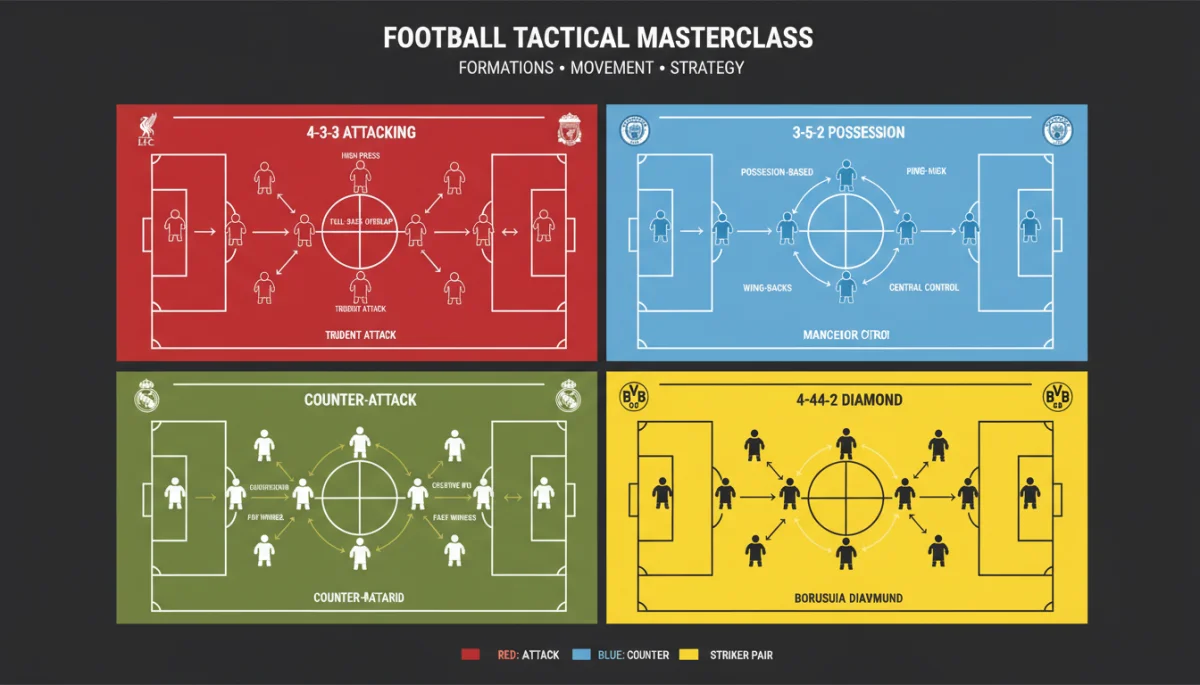
Teams like Chelsea have effectively utilized variations of the 3-5-2, adapting it to the specific challenges of the Women’s Champions League. Their approach often involves high-energy wing-backs who cover significant ground, transitioning quickly from defense to attack and providing key crosses.
Chelsea’s balanced 3-5-2 application
- Strong central block: Three center-backs provide a formidable defensive foundation, making it difficult for opponents to penetrate through the middle.
- Wing-back influence: Wing-backs are vital for both defensive cover and offensive width, creating overloads on the flanks.
- Two-striker threat: The two forwards work in tandem, allowing for both target play and runs in behind defenses, creating multiple attacking dimensions.
The 3-5-2 enables Chelsea to absorb pressure effectively before launching incisive counter-attacks, leveraging the speed and technical ability of their wing-backs and forwards. This tactical discipline and versatility make them a formidable opponent.
Ultimately, the 3-5-2 is proving to be a highly effective formation for teams that can execute its demands, balancing defensive resilience with potent attacking opportunities, as seen with Chelsea’s strategic deployment.
The compact 4-2-3-1: Midfield dominance and quick transitions
The 4-2-3-1 formation continues to be a popular choice in the Women’s Champions League 2026, evolving to emphasize midfield dominance and rapid transitions. This system is particularly effective for teams that prioritize control in the central areas and look to launch quick attacks through a creative attacking midfielder.
The two holding midfielders provide a protective screen for the defense and act as a springboard for attacks, while the attacking midfielder (number 10) orchestrates play, linking with the lone striker and two wide attackers. This structure allows for both defensive solidity and offensive flair.
Lyon’s strategic 4-2-3-1 deployment
Lyon, a perennial powerhouse, has often employed a refined 4-2-3-1, adapting it to maximize the impact of their world-class players. Their system focuses on suffocating opponents in midfield and exploiting spaces with speed and precision, a hallmark of their tactical evolution.
- Double pivot: The two central midfielders provide defensive stability and facilitate ball progression, controlling the tempo of the game.
- Creative number 10: A highly skilled attacking midfielder operates in the space between the opponent’s defense and midfield, creating chances and scoring goals.
- Explosive wingers: Wide players offer pace and dribbling ability, stretching defenses and cutting inside to shoot or cross.
Lyon’s ability to seamlessly transition from defense to attack, combined with their midfield control, makes their 4-2-3-1 a truly potent formation. They leverage individual brilliance within a disciplined structure, ensuring both tactical integrity and offensive threat.
In conclusion, the 4-2-3-1 remains a cornerstone formation, especially when deployed with the strategic intelligence and player quality seen in teams like Lyon, allowing for both defensive solidity and dynamic attacking play.
Arsenal’s dynamic 4-4-2 diamond: Pressing and central overloads
Arsenal’s tactical approach in the Women’s Champions League 2026 is expected to feature a dynamic interpretation of the 4-4-2 diamond, a formation designed to create central overloads and facilitate aggressive pressing. This system, while less common, offers unique advantages for teams seeking to dominate the midfield and unleash two central strikers.
The narrow midfield diamond allows Arsenal to swamp central areas, winning second balls and quickly transitioning into attack. The full-backs are crucial for providing width, while the two strikers can operate closer together, combining effectively in the final third.
Key elements of Arsenal’s diamond formation
- Midfield congestion: The four central midfielders create numerical superiority, making it difficult for opponents to play through the middle.
- High pressing intensity: The compact nature of the formation enables effective pressing traps, forcing opponents into errors.
- Two-striker partnership: Two forwards provide a constant threat, offering varied runs and combination play.
Arsenal’s use of the 4-4-2 diamond is about controlling the game’s rhythm through midfield battles and then exploiting the channels with swift attacking movements. It requires immense work rate from all players, especially the full-backs and the tip of the diamond, to cover ground and maintain balance.
This formation, when executed with precision, can be incredibly difficult to play against, as it combines defensive compactness with a direct attacking threat. Arsenal’s ability to master this system will be a fascinating aspect of the 2026 campaign.
To summarize, Arsenal’s 4-4-2 diamond represents a bold tactical choice, aiming for midfield domination and incisive attacking play through a highly coordinated and energetic approach.
Comparative analysis: Strengths and weaknesses of top teams’ tactics
Comparing the tactical evolutions of these four top teams – Barcelona, Chelsea, Lyon, and Arsenal – reveals distinct philosophies and adaptations for the Women’s Champions League 2026. Each formation brings inherent strengths and weaknesses, dictating how teams approach different opponents and game situations.
Barcelona’s 4-3-3 emphasizes possession and fluid positional play, aiming to wear down opponents. Its strength lies in its offensive versatility and control, but it can be vulnerable to quick counter-attacks if possession is lost high up the pitch, leaving defensive spaces.
Chelsea’s 3-5-2 prioritizes defensive solidity and powerful transitions. Its main advantage is numerical superiority in defense and dynamic wide play. However, it relies heavily on the stamina and defensive discipline of the wing-backs, who must cover immense ground. If they are caught out of position, the flanks can become exposed.
Lyon’s 4-2-3-1 focuses on midfield control and creative attacking through the number 10. This allows for both defensive stability and a clear attacking focal point. A potential weakness is the isolation of the lone striker if the midfield struggles to provide adequate support, or if the number 10 is effectively marked out of the game.
Arsenal’s 4-4-2 diamond aims for central overloads and aggressive pressing. Its strength is dominating the midfield and creating numerous scoring opportunities through two strikers. The primary challenge is the lack of natural width, which demands exceptional work rates from full-backs and potentially leaves them vulnerable to wide attacks if opponents exploit the flanks effectively.
The strategic battle in the Women’s Champions League 2026 will largely hinge on how these teams exploit their strengths while mitigating their weaknesses against diverse opposition. The ability to adapt in-game will be paramount for success.
In conclusion, the tactical choices of top teams reflect their core philosophies, each presenting a unique set of advantages and challenges that will define their performance in the upcoming Women’s Champions League.
| Key Tactical Trend | Brief Description |
|---|---|
| Positional Fluidity | Players interchange roles dynamically, blurring traditional positions for tactical advantage. |
| Hybrid Formations | Teams often blend elements of different formations, adapting in real-time based on game state. |
| Intense Pressing Schemes | High-intensity pressing from the front and midfield to disrupt opponent build-up. |
| Wing-back Importance | Crucial role of wing-backs in providing width defensively and offensively in multi-defender systems. |
Frequently asked questions about Women’s Champions League tactics
Tactical formations are becoming more fluid and adaptable, moving beyond rigid systems. Teams are focusing on positional interchangeability, high pressing, and versatile players who can perform multiple roles, allowing for dynamic transitions between offensive and defensive shapes throughout matches.
Teams like Barcelona, Chelsea, Lyon, and Arsenal are at the forefront. Barcelona excels with a fluid 4-3-3, Chelsea utilizes a strong 3-5-2, Lyon deploys a strategic 4-2-3-1, and Arsenal often employs a dynamic 4-4-2 diamond, each adapting their systems to maximize player strengths and opponent weaknesses.
Positional fluidity is crucial for creating numerical advantages in different areas of the pitch, making teams unpredictable. It allows players to seamlessly switch roles, confuse defenders, and exploit spaces, leading to more complex attacking patterns and defensive structures that are harder to break down.
These tactical shifts significantly influence game outcomes by dictating ball possession, creating scoring opportunities, and limiting opponent threats. Teams that can execute their chosen formation with discipline and adapt effectively in-game often gain a decisive edge, leading to more competitive and engaging matches.
Individual players are more critical than ever, needing high technical skill, tactical intelligence, and physical versatility. Their ability to understand complex instructions, adapt to changing roles, and execute precise actions within the team’s framework is fundamental to the success of these advanced tactical formations.
Conclusion
The Women’s Champions League 2026 is poised to be a showcase of tactical innovation and evolution in women’s football. As top teams like Barcelona, Chelsea, Lyon, and Arsenal continue to refine their formations and strategies, the game becomes ever more sophisticated. The emphasis on player versatility, fluid systems, and intelligent adaptation highlights a future where tactical ingenuity will be as crucial as individual brilliance. Fans can anticipate a thrilling competition, defined by the strategic battles unfolding on the pitch.
